01
Water entering now
Dripping, wet drywall, or new moisture needs an on-site evaluation. Keep people and belongings clear of affected electrical fixtures.
Roof repair + leak detection · Florida
A clearer answer starts with the whole roof.
A stain, a returning drip, a concern beneath solar. GreenReady connects what you see inside with the conditions above, then helps you understand the right next step.
A straightforward starting point
GreenReady evaluates residential roof leaks in Sarasota, Manatee County, Lakewood Ranch, Tampa Bay and Southwest Florida. The review considers tile, metal, shingle and flat or low-slope assemblies, visible moisture, flashing, drainage and existing solar interfaces. Findings and access limits guide a written proposal for repair, further investigation or a broader roof discussion.
01 / Roof Problem Triage
Choose what you know about the roof, the concern and any solar system. Your answers become an evaluation path and an inspection brief you can share.
Signals worth evaluating
A visible symptom is a reason to investigate. Its location or appearance alone cannot establish the exterior source.
Dripping, wet drywall, or new moisture needs an on-site evaluation. Keep people and belongings clear of affected electrical fixtures.
A mark that reappears after rain can indicate that the original pathway or a connected condition remains unresolved.
The first visible interior mark is evidence to document—not proof of the exact exterior entry point.
Broken or displaced tile, lifted shingles, open seams, damaged flashing, or disturbed edge conditions deserve professional review.
Wind-driven rain and storm debris can affect roof surfaces, transitions, and rooftop equipment in different ways.
Staining below or near an array calls for coordinated attention to both roof conditions and the solar interface.
Start from a safe place.Photograph interior changes and note when they appear. Leave wet, damaged roofs and electrical areas to qualified professionals.
02 / Repair considerations by roof type
The surface material matters. So do the layers beneath it, the surrounding condition and the details where materials meet.
A displaced or broken tile may be visible, but the water-control layers, flashings, valleys, transitions, and penetrations beneath and around it also matter. Access and matching materials can influence the proposed repair path.
Metal-roof leak evaluation can involve seams, fasteners or clips, penetrations, edge conditions, sealants, flashings, and movement at transitions. The surrounding panel condition and access determine whether a localized scope is practical.
Missing, lifted, creased, or damaged shingles can be part of the story. A useful evaluation also considers flashing, valleys, penetrations, decking indications, prior repairs, and the condition of the surrounding field.
On low-slope assemblies, drainage, seams, transitions, penetrations, curbs, edges, ponding indications, and membrane condition can all shape the investigation. The interior stain may be distant from the exterior entry point.
Roof leaks + existing solar
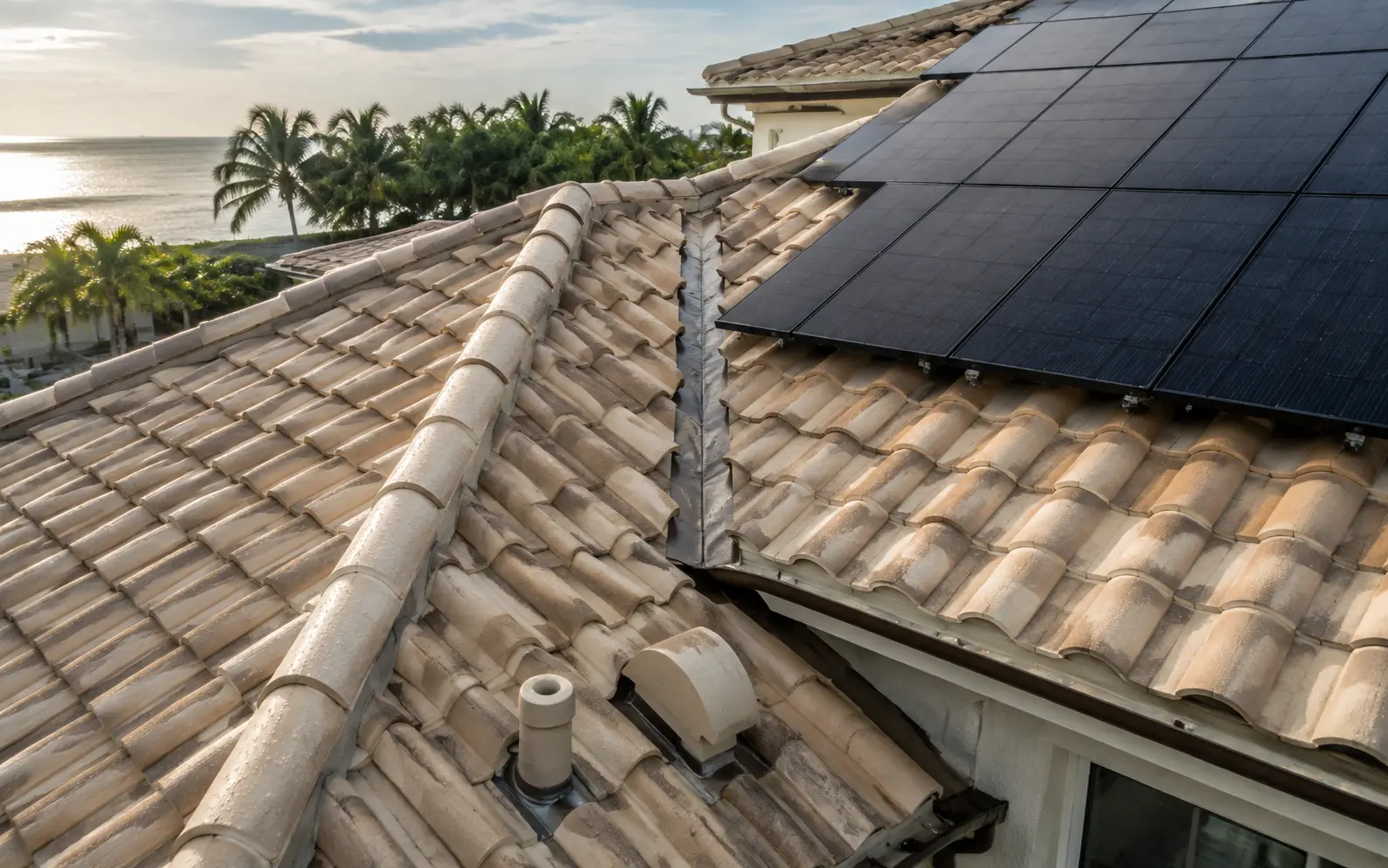
A leak near solar panels calls for a coordinated look at the roof, attachments, flashing, conduit and work access. Proximity alone does not establish the cause.
Existing systems + installer handoffs
If the installer is unavailable, the system is offline or earlier work is unclear, start with the present condition and the records you have. Equipment support and repair feasibility need a project-specific review.
Request a Coordinated EvaluationCompare the roof evidence with accessible solar-interface conditions and the stated system problem.
Panel removal is not automatic. Define any detach-and-reset scope when access requires it.
Prior-provider warranties, product coverage and new contracted work retain their own terms.
Repairing a roof does not itself establish why a solar system is offline or restore its production.
03 / Your inspection + repair journey
Explore the five stages at your own pace. Each step makes the findings, open questions and responsibilities easier to understand.
YOUR REPAIR JOURNEY / 01
Share what you see, when it happens and what has already been tried. Your roof and solar details help establish the inspection priorities.
Visible symptom and affected room
Weather, timing and previous repair history
Roof type and known solar status
YOUR REPAIR JOURNEY / 02
Compare accessible interior evidence with the roof surfaces, transitions, flashing, drainage and solar-interface conditions.
Observed roof and interior conditions
Safe access and inspection limitations
Whether further testing or access is needed
YOUR REPAIR JOURNEY / 03
The findings should make clear what is known, what is suspected and what still needs investigation before a repair is chosen.
Plain-language explanation of observations
Connected conditions and remaining questions
Any limits to identifying the water pathway
YOUR REPAIR JOURNEY / 04
A localized repair, additional investigation, solar access or a replacement discussion may follow. The conditions determine which path makes sense.
Proposed work, alternatives and exclusions
Materials, repair access and solar coordination
Price and any additional approval points
YOUR REPAIR JOURNEY / 05
Clarify the work sequence and responsibilities for the scope you approve, including applicable permits, completion records and support.
Work sequence and scheduling factors
Manufacturer and limited workmanship terms
Completion documentation and contact path
GreenReady, LLC · Published Florida credentialsRoofing CCC1335977 · Building CBC1267098 · Electrical EC13008201
What shapes the schedule?Weather, safe access, leak conditions, materials, solar coordination and any applicable permits. Availability and timing are confirmed for the property.
Repair versus replacement
A leak does not automatically mean a new roof. The extent of the problem and the condition around it should explain the recommendation.
A LOCALIZED REPAIR MAY FIT
A BROADER REVIEW MAY HELP
A coordinated approach
Use the proposal to connect the roof findings, solar needs and the work you approve. Each responsibility should have a clear place.
| Decision point | What the written plan should clarify |
|---|---|
| Inspection | Observed conditions, access limits and whether additional investigation is needed. |
| Solar access | Whether panels must move, which equipment is involved and who is responsible for each step. |
| Proposed repair | Materials, repair boundaries, price, alternatives and exclusions. |
| Work sequence | Scheduling factors, any applicable permits, handoffs and additional approval points. |
| Completion + support | Work records, applicable warranty documents and the path for reporting a concern. |
The GreenReady Guarantee
A roof repair can involve several different responsibilities. The written terms identify what applies to your specific products and contracted work.
Product eligibility, covered defects, registration, exclusions and any labor provisions depend on the manufacturer and warranty selected. A material warranty does not automatically cover every roof leak.
GAF warranty comparisonAny GreenReady limited workmanship warranty applies to the contracted work under its written project terms. Confirm the duration, covered work, exclusions and service-request process before authorizing the repair.
Explore the GreenReady GuaranteeDocument earlier repairs, concealed conditions, unrelated deterioration and existing roof or solar warranties. A new repair does not automatically extend coverage to an entire roof or take over another provider’s obligations.
Review the scope checklistFlorida homeowner questions
Understand the evaluation, solar coordination and repair decision before the first visit.
Ask GreenReadyNot reliably by itself. Water can move along decking, framing, underlayment, fasteners, or other surfaces before it becomes visible indoors. The stain is an important clue, but an on-site evaluation should compare it with the roof assembly and connected exterior conditions.
A dry stain can still document a past or intermittent moisture pathway. Record when it appeared, photograph any changes, and note the weather conditions. An evaluation can help determine whether there is an active condition, a prior condition, or a need for further testing.
Yes. GreenReady can evaluate the roof problem and the solar interface together, including accessible attachments, penetrations, flashing, conduit paths, and array-access considerations. The appropriate scope depends on the conditions found and may require separate roof and solar work steps.
GreenReady can evaluate the current roof and solar conditions and develop a proposed takeover or corrective-service path. That evaluation does not automatically transfer another provider's warranty or guarantee that every system can be restored; equipment, documentation, ownership, access, and condition all matter.
No. Removal is condition- and access-dependent. The leak location, array footprint, attachment layout, roof type, safe work area, and proposed scope help determine whether panels must be detached, whether limited access is possible, or whether another plan is more appropriate.
The decision considers the apparent extent of the problem, surrounding material condition, repair access, prior failures, roof age and assembly context, solar coordination, and whether a durable, supportable repair scope can be defined. Replacement is not assumed merely because a leak exists.
Permit needs depend on the work scope and the authority having jurisdiction. Florida's building code provides the statewide framework, while local building departments administer permits and inspections. GreenReady should confirm the applicable path after the proposed scope is defined.
No. Insurance coverage and claim decisions belong to the insurer under the policy. GreenReady can document observed conditions and prepare a proposed contracting scope, but does not promise coverage, claim approval, or a particular settlement.
Timing depends on scheduling, weather, safe access, roof type, whether the leak is active during evaluation, material availability, solar coordination, permit requirements, and the scope selected. GreenReady does not promise an emergency response time or a universal repair duration.
Applicable manufacturer warranties depend on the product, original installation, eligibility and written terms. A product warranty is not blanket coverage for a roof leak. Any GreenReady limited workmanship warranty applies to the contracted repair scope under the written project terms. Ask for the duration, covered work, exclusions and service-request process before authorizing work; do not assume an entire existing roof or solar system receives new coverage.
This page is for homeowners in Sarasota, Manatee County, Lakewood Ranch, Tampa Bay, and Southwest Florida. Scheduling and project feasibility are confirmed for the specific property during intake.
Useful homeowner resources
Use official resources alongside the property-specific proposal, manufacturer documents and any guidance from your insurer.
Official state building-code resources and current code-development materials.
Contractor verificationThe state portal homeowners can use to verify regulated contractor-license records.
Insurance guidanceOfficial homeowner guidance on documenting damage, contacting an insurer, and understanding the claim process.
Existing solar systemsFederal resources on inspecting, testing, maintaining, and recovering existing photovoltaic systems after damage or failure.
Resource links reviewed September 6, 2026. Linked organizations do not endorse GreenReady. Scheduling is confirmed for the specific property in Sarasota, Manatee County, Lakewood Ranch, Tampa Bay or Southwest Florida.
Start with a clear conversation
Tell GreenReady what you are seeing, what roof you have and whether solar is part of the picture. Bring your triage brief to the conversation.
Schedule a Roof EvaluationInspection availability, repair feasibility and the proposed scope are confirmed for your property.